
分享会预告艺术家访谈vol1 第八届(2025)水泥公园现场艺术节
2025-12-19 2024
What's Your Own Trick
The 8th
(2025) CEMENT PARK
Live Art Festival
* 你是一招鲜吗?
——第八届(2025)水泥公园现场艺术节
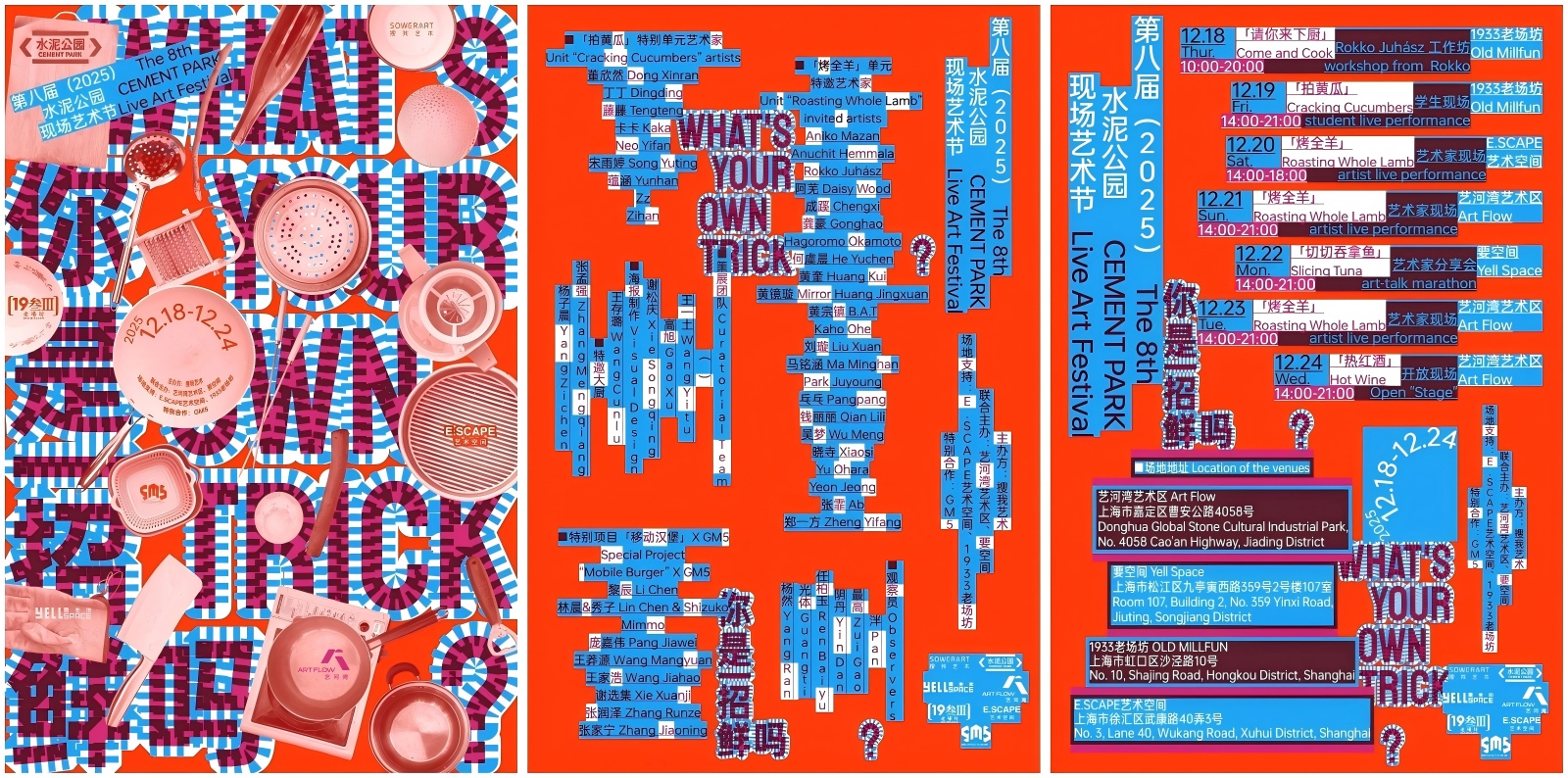
场地支持Venue Suport:
E.SCAPE艺术空间,1933老场坊
特别合作Special Colaboration:GM5
12.18 (Thur.) 「请你来下厨」艺术家Rokko Juhász工作坊
12.19(Fri.)「拍黄瓜」特别单元
12.20(Sat.)「烤全羊」艺术家现场
12.21 (Sun.)「烤全羊」艺术家现场
12.22(Mon.)「切切吞拿鱼」艺术家分享会
12.23(Tue.)「烤全羊」艺术家现场
12.24(Wed.)「热红酒」开放现场

「切切吞拿鱼」艺术家分享会
「Slicing Tuna」Art Talk Marathon
* 12.22(周一,Mon.),14:00-21:00,要空间 YELL SPACE
哈罗,亲爱的朋友,欢迎光临第八届水泥公园艺术节——你是一招鲜吗?我们想通过这个主题的设置,让各位艺术家更深入地挖掘自己的创作思路和方法 ,并分享出来,与此同时互相挖掘、互相激发 。作为艺术节的其中一个交流环节,我们设立了这个小小的采访,邀请了六位有着不同背景、视野、问题意识的观察员,对各位艺术家进行提问。文档的最后会有这六位观察员的简介。以下是ta们的提问,你可以选择其中至少4个问题进行回答,回答问题的数量不设上限。访谈内容会在艺术节开幕前发出。感谢你的参与!Hello, dear friend, and welcome to the 8th Cement Park Art Festival——What’s your own trick? Through this theme, we aim to encourage artists to delve deeper into their creative thinking and methods, share their insights, and, in the process, explore and inspire one another. As part of the festival’s communicative activities, we have set up this brief interview and invited six observers with diverse backgrounds, perspectives, and problem-awareness to ask questions to the artists. The profiles of these six observers are provided at the end of the document. Below are their questions. You may choose to answer at least four of them, with no upper limit on the number of questions answered. The interview content will be published before the festival opens. Thanks for your participation.
策划团队Curatorial Team
光体Guang Ti
泮Pan
任柏玉Ren Baiyu
最高tsehgiH
杨然 Yang Ran
阴丹 Yin Dan
钱丽丽 Qian Lili
Q: 你最喜欢吃什么菜?你认为这个偏好与你的创作有关系吗?如果有的话是什么关系?
What's your favorite cuisine? Do you think this preference has anything to do with your creation? If so, what kind of relationship is it?
A: 最近喜欢吃三文鱼,可能有关系,蛋白质高的食物让人有胃口去做作品
I've been into eating salmon lately. Maybe there's a connection—high-protein foods give me an appetite for making artworks.
Q: 现场中使用到的物品,它们的隐喻重要吗?
Are the metaphors of the items used in performance important?
A: 这个因人而异,它只是表达的语法,不适合每个人!对我而言,我会经常用到,这种间接的表达方式比较适合我!
It varies from person to person. It's just a kind of expressive grammar—it doesn’t suit everyone! For me, I often use it; this more indirect approach fits me better.
Q: 你最喜欢读的书是哪几本?
Which books are your favorites to read?
A: 曾经喜欢过昆德拉的小说,《不朽》《笑忘录》等
I used to enjoy Kundera's novels, like "Immortality" and "The Book of Laughter and Forgetting."
Q: 一年中有多少时间不做作品?
How much time is spent not working on the project throughout the year?
A: 一半时间
Half the time
Yu Ohara
Q: 你最喜欢吃什么菜?你认为这个偏好与你的创作有关系吗?如果有的话是什么关系?
What's your favorite cuisine? Do you think this preference has anything to do with your creation? If so, what kind of relationship is it?
A: 我喜欢含花椒的菜。舌尖的麻和辣不同,它不会造成那种“想吃却没法吃”的障碍。辣是痛觉,它放大食物温度的感知,同时钝化鲜味的感受。而且吃辣时会出汗,结果反而消耗了体力(尽管进食本应补充能量!)。当我把这个感受联系到创作实践,尤其是行为艺术时,“麻”并非意味着日常与非日常之间的清晰切换。我设想的是一种像花椒那样,在行动本身内部并行运作的东西。换句话说,艺术行为的生成并非通过切换某个触发器或剧烈转变自身状态,而是借助某种“香料”,让它作为日常生活的延伸浮现出来。
I like dishes that contain huajiao. The numbing sensation on the tongue is different from spiciness; it does not interfere with eating in the sense of“wanting to eat but being unable to.” Spiciness is pain, it heightens sensitivity to the temperature of food and dulls the perception of umami. In addition, you sweat while eating and end up expending physical energy (even though eating is supposed to restore energy!).When I think about this in relation to my creative practice,especially performance, numbness is not about a clear-cut shift between the everyday and the non-everyday. Rather, I imagine something that operates in parallel within the act itself, like huajiao. In other words, instead of switching a trigger or dramatically transforming one’s state of being, the artistic act comes into being through a kind of “spice” that allows it to emerge as an extension of everyday life.
Q: 您在以色列的交流经历是否给您的艺术实践带来了不同的视角?
Did your exchange experience in Israel bring about a different perspective to your artistic practice?
A: 在以色列交换期间,我曾随课程拜访过一个仍在运作中的基布兹——那种小型社会主义风格的集体村庄。那个基布兹位于沙漠中,我在那里参加了一次工作坊。其间有一次,所有参与者围成一个非常大的圆圈,一起静坐了一段时间。尽管我能看见其他参与者,但圆圈实在太宽,声音无法传递到对面。这种在开阔空间里彼此可见却不可闻的情境,对我来说是一种全新的体验。逗留期间,我还看到了艾瑞斯·内舍尔(Iris Nesher)的作品《时光之外》(Out of Time)。这件作品以幻灯片形式展示了一系列照片,拍的是她的孩子在博物馆和画廊里睡着的样子,看起来似乎很无聊。起初我共情于那个孩子,不觉微笑起来,心想“无聊的话当然会睡着”。我觉得这是件温暖而引人投入的作品,于是去读了说明文字。在那里,我得知孩子其实早已在一次交通事故中不幸离世。这个事实令我震惊,也在那个瞬间彻底改变了我对作品的印象。孩子仿佛被展示在博物馆中——一个以近乎半永久方式保存艺术品的地方——而我在那个画面里感受到一种肃穆。同时,我也深刻意识到艺术家无法衡量的爱与悲痛,以及将这样的作品呈现在公共空间所包含的深刻冲突。通过这段经历,我意识到文字——在这里是事实信息——的力量,进而也认识到艺术何其依赖于其周围制度框架的影响。从那以后,我的兴趣转向了对“观看艺术”如何被定义的质疑,并开始将实践聚焦于观看这一行为与概念本身。
During my exchange program in Israel, as part of a class, I visited a kibbutz, one of the small, socialist-style communal villages in operation. That kibbutz was situated in the desert, and I participated in a workshop there. At one point during the workshop, all the participants formed a very large circle and sat together for a certain amount of time. Although I could visually recognize the other participants, the circle was so wide that voices could not reach across it. This situation, being able to see one another but not hear each other in an open space, was a completely new experience for me.During my stay, I also encountered a work by Iris Nesher titled Out of Time. The piece consisted of a slideshow of photographs showing her child sleeping in museums and galleries, seemingly bored. I initially empathized with the child and found myself smiling, thinking,“Of course you’d fall asleep if you’re bored.” I felt it was a warm and engaging work, which led me to read the caption. There, I learned that the child had tragically already passed away in a traffic accident. This revelation was shocking, and in that moment, my impression of the work changed completely. The child appeared almost as if they were being exhibited within the museum, a place where artworks are preserved in an almost semi-permanent way, and I felt a sense of solemnity in that image. At the same time, I became deeply aware of the immeasurable love and grief of the artist, as well as the profound conflict involved in presenting such a work in a public space.Through this experience, I came to realize the power of text, in this case, factual information, and, by extension, how art relies heavily on the influence of the institutional frameworks surrounding it. From there, my interest shifted toward questioning how“viewing art” is defined, and I began to focus my practice on the act and concept of viewing itself.https://www.herzliyamuseum.co.il/en/exhibition/iris-nesher/
Q: 行为对你来说是什么?
What does performance art mean for you?
A: 对我而言,行为艺术意味着自身成为作品,同时又是它的第一观看者。这里所说的“自我”,并非由外部指示或强迫塑造而成。相反,它是根植于闲暇之乐的一种存在——一种被允许在每一刻去选择那浮现的意志的状态。
For me, performance art means becoming the artwork oneself, while at the same time being its first viewer. The “self” I refer to here is not something formed through external instructions or coercion. Rather, it is an existence grounded in the enjoyment of leisure—a state in which one is allowed, moment by moment, to choose the will that arises.
Q: 你能分享一些你觉得有趣的事情的例子吗?
Could you share some examples of things that you find funny?A: A person who, exhausted after work, sits in a priority seat on the train, only to find themselves surrounded by a group of elderly people returning from a day out and subjected to silent pressure.Someone who tries to deal with a situation using words that completely ignore the context.
A person who has no idea what is going on at all but laughs anyway after reading the atmosphere.Cats.
一个工作疲惫的人坐上地铁的优先座位,结果被一群郊游归来的老人无声包围,承受着无形的压力。试图用完全脱离语境的言语来应对局面的人。完全搞不清状况却察言观色跟着笑的人。猫。
Q: 你是谁?
Who are you?
A: 前些天非常感谢你。
Thank you very much for the other day.
Q: 你会看重哪些生活中的“行为”?
What kinds of 'behaviors' in daily life do you value?
A: 睡眠——尤其是那种极其舒适的睡眠。
Sleeping—very comfortably, above all.
Q: 你作品之间的彼此联系是什么?
What is the connection between your works?
A: 我倾向于创作基于即兴、或基于能以不设防的自然状态行动的情境的作品,并将这些情境本身视为作品。由于我认为自己既是艺术品又是其观看者,我希望作品中包含一种自省意识,以及某种带有讽刺或疏离感的距离。不过,这能否在作品中真正可见,仍是一个开放的疑问。
I tend to create works that are based on improvisation, or on situations in which I can act in an unguarded, natural way, and to treat those situations themselves as the work. Since I think of myself as being both the artwork and its viewer at the same time, I want my works to contain a sense of introspection and a certain ironic or detached distance. However, whether this is actually made visible in the work remains an open question.
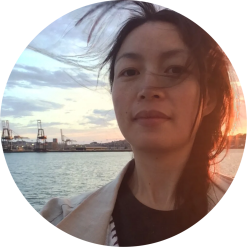
吴梦 Wu Meng
Q: 你最喜欢吃什么菜?你认为这个偏好与你的创作有关系吗?如果有的话是什么关系?
What's your favorite cuisine? Do you think this preference has anything to do with your creation? If so, what kind of relationship is it?
A:我喜欢苏州初夏的塘鲤鱼炖蛋,也喜欢草头……但吃来吃去还是觉得一碗苏式面最合胃。这跟创作的关系……可能没那么玄妙。我们喜欢的食物常连着最初的世界,小时候的味觉记忆塑造了我们感受舒服自在的底子。如果是自己来熬制这个汤头,我不喜欢去查阅菜谱,那种感受回忆后操作的过程才能让自己和这件事真正连接起来。千变万化但似乎又有迹可循。我自己的创作也总是这样,体悟很重要……另一个层面,创作不是怀旧,而是试图在变化中看清:当一碗面的汤底从熬制变成勾兑时,我们失去的究竟是什么?这个什么,往往就是艺术想触碰的东西。
I love the braised egg with pond carp in early summer in Suzhou, and I also love clover... but after tasting various dishes, I still find a bowl of Su-style noodles the most comforting. Its connection to creation... might not be that mysterious. The foods we enjoy are often tied to our earliest world—the taste memories from childhood shape the foundation of how we feel comfort and ease.If I were to simmer this broth myself, I wouldn’t like to look up a recipe. It’s the process of recalling through feeling and then executing that truly connects me to the task. Ever-changing yet seemingly traceable. My own creative work is always like this—personal insight matters...On another level, creation isn’t about nostalgia, but an attempt to see clearly amidst change: when the broth of a bowl of noodles shifts from simmering to blending, what exactly do we lose? That “something” is often what art seeks to touch.
Q: 行为对你来说是什么?
What does performance artmean to you?
A: 我是一个剧场背景的表演者,有时也很难界定我做的是表演,还是行为,还是介于这两者之间的什么东西。很多时候,行为或者表演是自我存在的验证,是一种成为自己的过程。“行为艺术……这个概念本身是西方的。我更愿意描述成做一件事情。人在特定时空里,用身体认真做一件事。意义是衍生产品。我不太喜欢用艺术把自己架起来,更关注的是:这个行为或者表演能不能让参与者(包括我自己)重新看到平时被忽略的生活。
As a performer with a theater background, I sometimes find it difficult to define whether what I do is performance, performance art, or something in between. Often, performance or performance art serves as a validation of self-existence—a process of becoming oneself."The concept of 'performance art' itself is Western. I prefer to describe it simply as doing something: a person, in a specific time and space, earnestly carrying out an action with their body. Meaning is a byproduct. I don’t like to elevate myself with the label of 'art'; what I care more about is whether this performance or action can allow the participants (including myself) to see aspects of daily life that are usually overlooked."
Q: 你觉得自己现在做行为,和20年前做行为,在意的事情发生了哪些变化?或许跟技巧有关,或许跟方法有关,或许对于艺术的观念有关,或许跟生命经验有关?简单讲讲吧。
Do you think there have been any changes in the things you care about when you act now compared to 20 years ago? Maybe it's related to skills, maybe to methods, maybe to the concept of art, or maybe to life experiences? Please share your thoughts.
A: 20年前可能更在意表达什么,现在更在意是否真切。如何成为自己太难了,需要先弄清楚自己是什么。技巧当然进步了,但关键的变化或许是:以前觉得艺术是往生活里添加点什么,现在觉得艺术是把生活里多余的东西剥掉一点,让原本被遮蔽的东西显露出一点点。
Twenty years ago, I probably cared more about what to express; now I care more about whether it feels genuine. Becoming oneself is too difficult—you must first understand what you are. Technically, of course, I’ve improved, but perhaps the essential shift is this: I used to think art was about adding something to life, but now I feel art is about peeling away a little of the excess in life, allowing what was hidden to emerge, even if just a little.
Q: 你如何理解工作坊、即兴行为和剧场表演这三件事,或者它们是一件事?
How do you understand the concepts of workshop, improvisation and theatrical performance, or are they all the same thing?
A: 可以想象成同一次呼吸的不同阶段:工作坊是吸气(收集群体的无意识),即兴是屏息(悬置理性的瞬间),剧场是呼气(朝向他者的释放)。
It can be imagined as different phases of the same breath: the workshop is inhalation (gathering the collective unconscious), improvisation is holding the breath (a moment of suspending rationality), and theater is exhalation (release toward others).
Q: 醒来的第一件事是什么?
What is the first thing to do after waking up?
A: 哈哈哈,睁开眼睛吧。这听起来像个玩笑,但仔细想想:从睡眠的无意识状态回到清醒,我们每一天都重新进入世界。我通常会躺半分钟,不急着抓手机,让意识慢慢苏醒。这半分钟里没有我,只有光线、声音和身体的感觉。我喜欢这个片刻的空白。
Hahaha, open your eyes. It sounds like a joke, but think about it: from the unconscious state of sleep back to wakefulness, we reenter the world every day. I usually lie there for half a minute—not rushing to grab my phone—letting awareness slowly return. In those halfminutes, there is no “me,” only light, sound, and bodily sensation. I love this little stretch of blank space.
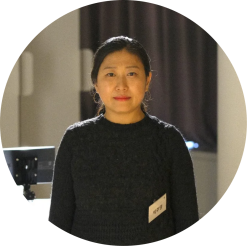
Park Juyoung
Q: 你最喜欢吃什么菜?你认为这个偏好与你的创作有关系吗?如果有的话是什么关系?
What's your favorite cuisine? Do you think this preference has anything to do with your creation? If so, what kind of relationship is it?
A: 是辣炒年糕。需要的材料很简单:只有年糕、辣椒酱和糖。就像创作过程中也会有失败一样——无论再加多少辣椒酱或糖,有时味道就是不对。特别是,我做饭还挺糟糕的。
It’s tteokbokki. (hot ricecake)The ingredients are simple: just rice cakes, gochujang, and sugar.Just as there are failures in the creative process, no matter how much gochujang or sugar you add, sometimes it simply doesn’t taste good.Especially, my cooking is pretty terrible.
Q: 你的艺术实践如何体现身体政治的视角?这与其他涉及身体的艺术家实践有何不同?
How does your artistic practice realise a body politics perspective? How does this differ from other artists' practices concerning the body?
A: 我专注的是视觉化,而非政治或社会取向。身体行动的极限依据携带何物、移动至何处而成为语言符号。
I focus on visualization rather than on political or social orientations.The limits of physical action become linguistic signs depending on what object is carried and where it is moved.
Q: 行为对你来说是什么?
What does performance art mean for you?
A: 从不得不以嘴巴说出被这个世界规训的语言的不适中,我的身体所选择的姿态,成为了作品本身。
From the discomfort of having to speak, with my mouth, a language regulated by the world, the attitude my body chooses becomes the work itself.
Q: 你喜欢公园吗?
Do you like parks?
A: 是的,我喜欢这里。你可以独自前来,也可以与朋友同行。这是一个远离紧张、可以放松身心自由玩耍的地方,但也有必须遵守的公共礼仪,并且不能停留太久。
Yes, I like it. You can go alone or with friends.It’s a place where you can relax and play freely, away from tension, but there are public manners that must be observed, and you can’t stay for too long.
Q: 什么是听觉?
What is hearing?
A: 通常,声音通过耳朵被听见。但我回应的,是出现在我眼前的运动元素的姿态。例如,我将人多的地方感知为有许多声音,而无人的地方则感知为没有声音。
Usually, sound is heard through the ears.But I respond to the attitude of movement in the elements that appear before my eyes.For example, I sense places with many people as having a lot of sound, and places with no people as having no sound.
Q: 你的创作为什么和身体有关?你觉得消费身体和借身体表达区别是什么?
Why is your artistic practice related to the body? What do you think is the difference between consuming the body and using it as a means of expression?
A: 施加于身体的消费性行动,是对问题的一种指向性回应。其结果,留下的是身体的界限与精神的虚空。而表达性行动,则是与所有在场元素相关的存在本身。如果说消费是历史,那么表达便是记录(痕迹)。
Consumptive actsphysically imposed on the body are a directional response to questions.As a result, physical limits and mental emptiness remain.Expressive action is existence itself in relation to all elements that are present.If consumption is history, then expression is a record (trace).
乓乓 Pangpang
Q: 你最喜欢吃什么菜?你认为这个偏好与你的创作有关系吗?如果有的话是什么关系?
What's your favorite cuisine? Do you think this preference has anything to do with your creation? If so, what kind of relationship is it?
A: 最喜欢吃的时候觉得好吃的,刚刚我吃了一份地道的大排面,虽然我的家乡和大排面不是来自同一个地方,喜欢食物带来的或轻或重的感受。我最喜欢吃小时候爱吃的东西,西瓜,绿豆汤,我仍然怀念它们过去和我共同的时光,吃它们就像一遍又一遍地看电影。如果说和创作有什么关系的话,就是食物变成了身体的一部分但它们还是食物,还是“西瓜”或者“绿豆汤”,世界上没有两杯相同的绿豆汤。
I love eating what tastes best in the moment—I just had an authentic pork chop noodle soup. Though my hometown isn’t where this dish comes from, I enjoy the light or weighty sensations food brings.What I love most is eating what I loved as a child—watermelon, mung bean soup—I still miss the time they once shared with me. Eating them is like watching a film again and again.If there’s any connection to creation, it’s that food becomes part of the body yet remains food, still “watermelon” or “mung bean soup.” There are no two identical bowls of mung bean soup in the world.
Q: 你怎么看待生活经验和创作的关系?
How do you view the relationship between life experience and artistic practice?
A: 我很希望做一些行为对我的生活带来影响,觉得那是必然发生的事,在我做一些事情的时候我运行在它的里面。
I really hope that the actions I do will bring influence to my life—I feel it’s something necessary, and when I engage in them, I operate within it.
Q: 行为对你来说是什么?
What does performance art mean for you?
A: 是一个次元口袋。
It's a dimensional pocket.
Q: 你觉得爱情是什么?
What do you think love is?
A: 我觉得爱情是一艘船,坚固,美丽,永久。如果单独追踪它的今生前世,它会退役,会沉没,但是大洋里面的船从古到今。
I think love is like a ship,sturdy, beautiful, permanent. If we trace the life of just one vessel, it may be decommissioned, it may sink—but ships in the ocean, from ancient times to the present day, go on.
Q: “准时”对你而言有何不便?
What inconveniences does "punctuality" pose for you?
A: 自己来说我喜欢准时,但是有准时就有不准时,对我的不便应该是落差。
Personally, I like being punctual—but with punctuality comes unpunctuality. What inconveniences me is probably the gap between the two.
Q: 你作品之间的联系是什么?
What are the connections between your works?
A: 我经常在做声音,往往声音是它们的联系。但是我有时候会想怎么叙述,叙述起来是什么样子,比如我告诉我朋友,刚才我看见一个人在干什么,甚至是不知道该怎么形容。我觉得这种叙述是牢固的联系。
I often work with sound—sound often becomes their connection. But sometimes I think about how to narrate it, what form the narration would take. For example, when I tell a friend, “Just now I saw someone doing something,” I might even struggle to find the words. I feel this kind of narration is an enduring connection.
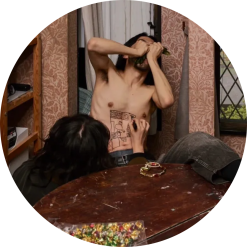
Hagoromo Okamoto
Q: 你最喜欢吃什么菜?你认为这个偏好与你的创作有关系吗?如果有的话是什么关系?
What's your favorite cuisine? Do you think this preference has anything to do with your creation? If so, what kind of relationship is it?
A: 我并没有特别偏爱的菜系。我没有强烈的口味偏好,但对身体在特定时刻的需求——无论是饥饿、满足,还是介于两者之间的状态——非常敏感。这种对身体状态的敏感也反映在我的艺术实践中,我的创作常常专注于瞬间的身体性。
I don’t have a particular favorite cuisine.I don’t have strong taste preferences, but I am very aware of what my body is asking for in a given moment—whether it is hunger, satisfaction, or something in between.This sensitivity to my bodily state is reflected in my artistic practice, which often focuses on momentary physicality.
Q: 历史和记忆如何影响你的艺术实践?
How do history and memory influence your artistic practice?
A: 我不认为历史与记忆可以轻易被混为一谈。我感兴趣的,是一种根植于人类存在的、“朝向过去的意识”——比如后悔、乡愁、怨恨或愤怒。历史事件拥有一种强大的力量,能将这种意识从当下拉回过去。我的艺术实践,试图触碰那种朝向过去的运动,并将那些问题的本质带回当下。
I don’t think history and memory can be easily spoken of as the same thing.What I am interested in is a “consciousness toward the past” rooted in human existence—such as regret, nostalgia, resentment, or anger.Historical events have a strong force that pulls this consciousness from the present back toward the past.My artistic practice attempts to touch that movement toward the past and bring the essence of those issues back into the present.
Q: 请简单讲讲你的“quiet resistance"吧。
Please briefly explain your "quiet resistance."
A: “安静的抵抗”在我的表演实践中占据着重要的位置。从外表看,它或许是克制而微妙的,但其内部却伴随着一种沸腾的强度。这种抵抗源于强烈的内在冲突——自我从诸如父母、社会或传承的价值体系等他者形式中分离出来,并与它们对峙。对我而言,安静的抵抗,就是诞生于这种内在对峙本身的张力。
“Quiet resistance” occupies an important place in my performance practice.From the outside, it may appear restrained and subtle, but internally it is accompanied by a boiling intensity.This resistance emerges from strong inner conflicts, where the self becomes divided from forms of otherness—such as parents, society, or inherited systems of values—and confronts them.For me, quiet resistance is the tension that arises within that inner confrontation itself.
Q: 能否与我们分享你对历史、集体记忆与暴力产生兴趣的原因?
Could you share with us the reason why you are intrigued by the historical and collective memory and violence?
A: 我对历史、集体记忆与暴力的兴趣,始于我在加害史中感知到自身情结的隐喻时。身为男性却无法内化“男性气质”,拥有日本国籍却不完全持有稳固的“日本”认同,以及作为人类,我们都携带着伤害他人的可能性。我所探讨的暴力不限于直接的身体暴力,而是指向人类存在本身固有的暴力性。
My interest in history, collective memory, and violence began when I sensed a metaphor for my own complexes within the history of perpetration.Being male while not being able to embody “masculinity,” having Japanese nationality while not fully possessing a stable “Japanese” identity, and the fact that, as human beings, we all carry the potential to harm others.The violence I engage with is not limited to direct physical violence, but refers to the violence inherent in human existence itself.
Q: 你是好人吗?
Are you a good person?
A: 我不知道成为一个“好人”意味着什么,或者说,这种“好”是对谁而言的。即便我相信自己是好的,他人也未必这样看待。我唯一能确信的是,我是一个害怕自己可能并非好人的人。
I don’t know what it means to be a “good person,” or for whom that goodness exists.Even if I believe myself to be good, others may not see me that way.The only thing I can say for certain is that I am someone who is afraid of the possibility of not being a good person.
Q: 什么情况会服用药物?
Under what circumstances wouldyou take medicine?
A: 在我的日常生活中,我并不依赖药物。然而,我有时会发现自己对那些似乎受过度药物或酒精影响的人的动作感到着迷。
I don’t rely on medication in my daily life.However, I sometimes find myself fascinated by the movements of people who appear to be affected by excessive medication or alcohol.
Q: 你绘画作品和行为之间彼此的联系是什么?
What is the connection between your paintings and your performances?
A: 我的绘画揭示的是行动后留下的东西。虽然行为艺术与绘画运用身体的方式不同,但绘画旨在留下绘画行为本身的痕迹。两者之间的连接点,在于运用身体进行工作这一行为——无论那身体是在当下展开,还是以痕迹的形式被保存。
My paintings reveal what remains after an action has taken place.While the use of the body differs between performance and painting, painting aims to leave traces of the act of painting itself.What connects the two is the act of working with the body—whether that body is unfolding in the present moment or being preserved as a trace.
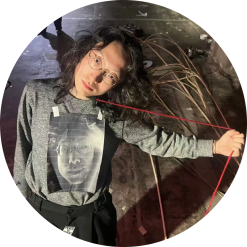
张霏 Ab
Q: 你最喜欢吃什么菜?你认为这个偏好与你的创作有关系吗?如果有的话是什么关系?
What's your favorite cuisine? Do you think this preference has anything to do with your creation? If so, what kind of relationship is it?
A: 最近喜欢吃牛蛙。没什么关系!
Lately, I've been enjoying eating bullfrog. No particular reason!
Q: 你是谁?
Who are you?
A: 我是Ab。
I'm Ab.
Q: 初中的时候写诗,没那个脑袋画画,活着的时候做现场。你的即兴行为和上个世纪的偶发艺术的根本区别是什么?
What is the fundamental difference between your improvisational actions and the art of happening the last century?
A: 也能装进偶发的概念里的,这些东西仍然都还很好用,和银版写真一样。
My improvisational actions can also be contained within the concept of the art of happening—the conecpt remains fully functional, like daguerreotypes.
Q: “偶发”的破坏性是什么,在生活中。
What is the "spontaneous" destructive power, in life?
A: 难道不是构建了什么吗?我试图多写一点。我觉得首先可能要跳出某种“发展”的固有观念,“破坏”与“构建”都服务于发展,但新与不新可能更个人化了。一个人如果想,在信息时代很快就会体会到人的尺度是如此的有限,所以能说到“破坏”的话,技术才是极具破坏性的那一个,而不是艺术,现在的一些艺术一直在试图找回“人”。
Isn't something being constructed? I'm trying to write a bit more. I think perhaps we must first step outside the fixed notion of "progress." Both "destruction" and "construction" serve progress, but what is new or not-new may have become more personal. If one reflects, in the information age, we quickly realize how limited the human scale truly is. So, if we speak of "destruction," technology is the overwhelmingly destructive force, not art. Much of contemporary art is precisely trying to retrieve the "human."
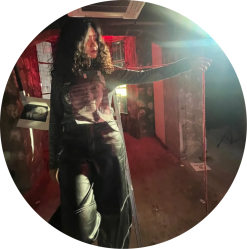
马铭涵 Ma Minghan
Q: 你最喜欢吃什么菜?你认为这个偏好与你的创作有关系吗?如果有的话是什么关系?
What's your favorite cuisine? Do you think this preference has anything to do with your creation? If so, what kind of relationship is it?
A: 什么都吃,什么好吃吃什么,尤其是平时不容易吃到的,比如旅行的时候,一定要吃当地特色,恶心都得尝一口那种。非要说关联性,可能我创作也是喜欢尝试新东西。
I eat everything, whatever tastes good, especially things not easily available in daily life. When traveling, for instance, I always make sure to try the local specialties—even if it might seem revolting, I’ll take a bite. If I had to find a connection, perhaps it's that my creative practice also shares this appetite for trying new things.
Q: 行为对你来说是什么?
What does performance art mean for you?
A: 一种习惯性的表达方式,就和影像装置一样,但是行为的准备更多在脑子里。
It's a habitual mode of expression, much like video installation, but the preparation for performance happens more inside the mind.
Q: 你骑过马吗?
Have you ever ridden a horse?
A: 还有点喜欢。这个问题是来自于我的姓氏吗?
I do like it a bit. Is this question coming from my surname?
Q: 有没有训练过身体的尺度和节奏,让身体精准传递信息?你对自己的身体信任吗?
Have you trained the body's timing and rhythm to enable it to accurately convey information? Do you trust your own body?
A: 没有,也不太信任,但我觉得这是好事,这能产生更多不可控性。其他的创作方式都太精确了,选择行为就是想要不精确,这是我笨拙的身体能够做到的最好的事。
No, and I don’t quite trust it either—but I think that’s a good thing. It generates more uncontrollability. Other ways of creating are too precise; choosing performance is a desire for imprecision, and that’s the best my clumsy body can do.
Q: 你认为重新观看自己的作品的“再解读”是必要还是多余的?
Do you think it is necessary or redundant to re-examine and reinterpret one's own works?
A: 是有趣的,我喜欢看别人表达我没想到的意涵,这跟对方的生活有关,可以看到不同的思维方式。
That's interesting—I enjoy seeing others express meanings I haven't considered. It’s connected to their life, and it lets me see different ways of thinking.
Q: 对60年代至今的行为作品中,最令你失望的作品是?
Which of the performance works from the 1960s to the present day do you find the most disappointing?
A: 失望的情绪多是来自于期待吧,看行为艺术作品我不会有事先的期待。可能对别的事物也是一样,我就是一个冷漠的现代小孩。
Disappointment often stems from expectation—when I watch performance art, I don’t go in with prior expectations. Maybe it’s the same with other things; I’m just a detached modern kid.
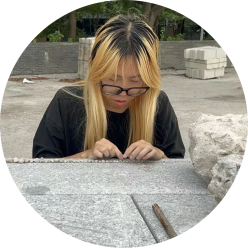
郑一方 Zheng Yifang
Q: 行为对你来说是什么?
What does performance artmean to you?
A: 因为我主要的创作媒介一直都是绘画,行为对我来说是一种“打开”,我打开我的身体,打开我的空间,用和以往不同的方式和角度去思考创作,它让我看到更多的关系。行为让我感受到了艺术的百无禁忌,我可以做的远比我以为的要多,回到绘画或者其他媒介中也一样。
Because my primary medium has always been painting, performance has been a kind of “unfolding” for me—I unfold my body, unfold my space, and think about creation in ways and from angles different from before. It has allowed me to perceive more relationships. Performance made me feel that in art, nothing is off-limits; I could do far more than I thought, and this holds true when returning to painting or any other medium.
Q: 最近在考虑作品的时候,什么想法会让你觉得可怕?
Recently, when thinking about your works, what idea would make you feel scared?
A: 发现自己在试图自圆其说的时候是最让我感到可怕的。因为自我梳理是必要的,我需要不断去向自己提出问题,回答问题,尽可能让自己的方法向思想靠近。但有的时候也会不知不觉陷入一个逻辑自洽的闭环,这时候一切看起来好像合理且成立,分不清楚自己是否在自圆其说,这其实很危险,必须保持警惕。
The most frightening thing for me is realizing I’m trying to make my own logic seem complete. Self-reflection is necessary—I need to keep posing questions to myself, answering them, and bringing my methods as close as possible to my thinking. But sometimes I unknowingly fall into a self-consistent closed loop. At that point, everything may appear reasonable and valid, and I can no longer tell whether I’m just making my own narrative sound coherent. That’s actually very dangerous, and I must stay alert.
Q: 你是谁?
Whoare you?
A: 我是1996年12月31日出生—和马蒂斯同一天生日—摩羯座—上升双鱼月亮处女金星射手—壬水—五行缺土—infp—不爱动——鼻炎很严重—喜欢宝可梦—最爱的动画是降世神通—喜欢留长头发—不喜欢二元性别划分—认为艺术是终生的战斗的郑一方。
I was born on December 31, 1996—sharing a birthday with Henri Matisse—Capricorn—with Pisces rising, Moon in Virgo, Venus in Sagittarius—Ren Water, lacking Earth in the Five Elements—INFP—not fond of physical activity—suffers from severe rhinitis—loves Pokémon—favorite animation is Avatar: The Last Airbender—prefers long hair—does not endorse binary gender divisions—Zheng Yifang, who believes art is a lifelong battle.
Q: 什么时候写诗,什么时候画画,什么时候做现场呢?
When to write poetry, when to paint, and when to perform live?
A: Q好久没写诗了,但一般会在不方便画画和行动的时候写诗,比如坐火车的时候,当然这也不是绝对的。经常会想要画画,但不是每次想画的时候都会去画,一般在觉得自己的状态、感受和时间还有环境适合的时候会画,类似于天时地利人和的时候,但是也不绝对,我可能还是更依赖某一刻的冲动吧。做现场更依赖冲动,一般我某段时间一直在想某些事,可能是因为发生了什么事件,也可能就是像平时一样在思考某个问题。就这样一直想着,会在某个时刻被突然冒出的某个场景、空间、物件、动作或者词语激活,突然就有了要在某处用某事物(如果有)做某个行为的冲动。本来好像无关的事物在我思考时产生了交集。
It's been a long time since I’ve written poetry, but I usually write when it’s inconvenient to paint or perform—for example, on a train—though this isn’t an absolute rule.I often feel like painting, but I don’t paint every time the urge comes. I usually paint when my state, feelings, time, and environment feel right—something like when all conditions align—but again, it’s not absolute. I probably rely more on a certain momentary impulse.Live performance relies even more on impulse. Usually, I’ll be thinking about certain things over a period of time—maybe because of some event, or just pondering a question as usual. I keep thinking, and at some point, I’m suddenly triggered by a scene, a space, an object, an action, or a word that pops up—and suddenly I have the urge to perform a certain action in a certain place with certain things (if there are any). Things that originally seemed unrelated intersect in my thinking.
Q: 什么是失败?
Whatis failure?
A: 我不知道怎么给失败一个定义,但是一般来说当我对我做的东西感到气馁的时候我会觉得自己失败了,但我不觉得失败是坏事,我总在失败之后知道我的下一步要做什么。
I don’t know how to define failure, but generally, when I feel discouraged about what I’ve done, I consider it a failure. Yet I don’t think failure is a bad thing—I always know what to do next only after failing.
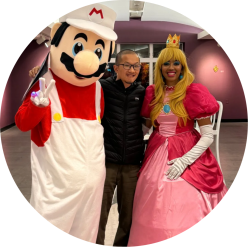
龚豪 Gonghao
Q: 你最喜欢吃什么菜?你认为这个偏好与你的创作有关系吗?如果有的话是什么关系?
What's your favorite cuisine? Do you think this preference has anything to do with your creation? If so, what kind of relationship is it?A: 最近喜欢吃锅子,有荤有素。冬天到了,需要吃点热的东西。应该算有点关系吧。“适时而动“ 比如我们今年开始造船和划船出发的时候我是看了黄历选的开工和出发的日子
I've been into eating hot pot lately, with both meat and vegetables. Winter's here, so we need something warm.It should be somewhat related."Acting in due season"For example, when we started building the boat and set out rowing this year, I chose the dates to start work and depart based on the traditional Chinese calendar.
Q: 分享一些你对船/水的理解和经验?
Could you share some of your understanding and experiences regarding boats/water?
A: 船:是一个可以在水上运输的工具。也有探索、冒险精神的象征。水:水就太牛逼了,地球地表面积71%都是水。我从小是“旱鸭子”,有两次差点溺水的经历。一次是八九岁的时候和姐姐在河边刷鞋子,我摇了枯树、树断了、我栽进河里,姐姐抓住了脚踝将我拉起。另一次是毕业前在隔壁大学的游泳池深水区,同学说你跳进来我接住你,然后我跳进去后,都喝了很多水,最后四个同学合力把我救起。现在下水都会穿救生衣。
Boat: A tool for transport on water. It also symbolizes exploration and adventure.Water: Water is just too incredible—71% of the Earth's surface is covered by it.I’ve been a “landlubber” since childhood and have had two neardrowning experiences.Once when I was about eight or nine, washing shoes by the river with my sister, I shook a dead tree—it broke—and I fell into the river. My sister grabbed my ankle and pulled me out.Another time was just before graduation, in the deep end of a neighboring university’s swimming pool. A classmate said, “Jump in, I’ll catch you.” After I jumped, I swallowed a lot of water, and in the end, four classmates worked together to pull me out.Now I always wear a life jacket when getting into the water.
Q: 行为对你来说是什么?
What does performance art mean for you?
A: 行为对于我来说是什么?这个问题还得继续深问就会有意思。日常动作是行为,但这个“日常动作”需要区别于我们常说的“做个行为”。相当于“日常”与“表演”的区别。如若永远没有观众,就不存在行为艺术
What is performance to me? This question becomes interesting the deeper you go.An everyday action is a behavior, but this “everyday action” needs to be distinguished from what we usually call “doing a performance.”It’s akin to the distinction between “the everyday” and “the performative.”If there were never an audience, performance art would not exist.
Q: 可以用三个词来形容你对“顺流而下”项目的理解/感受吗?
Can you describe your understanding/feelings of the "Going with the Flow" project in three words?
A: 美梦成真、互相帮助、解决问题
Dreams coming true, mutual support, solving problems.
Q: 还想念牛牛吗?
Do you miss Niu niu?
A: 偶尔会在路上见到别的约克夏喊他“牛牛”。后面我自己有了一只法斗
Sometimes on the street, I’d see other Yorkshire Terriers and call out “Niu Niu.” Later, I got a French Bulldog of my own.
Q: 为什么选择参加水泥公园?
Why did you choose to participate in Cement Park?
A: 18年邀请我的时候没能到现场,这次想补上。
I wasn’t able to be there when you invited me back in 2018—this time, I'd like to make up for it.
Q: 策展和做艺术家如果只能选一个你更倾向于哪个?未来更侧重于哪方面突破?
If you had to choose only one between curating and being an artist, which would you prefer? In the future, which area would you focus on for breakthroughs?
A: 这个问题有点烂,只能选一个的话会是艺术家。策划也是表达,像做一个作品。在作品表达和市场转化上突破一下
That's a bit of a lame question, but if I had to choose one, it'd be artist.Curation is also a form of expression, like making a work.I want to push for a breakthrough in both artistic expression and market translation.
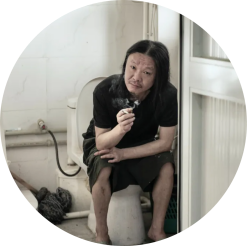
黄奎 Huang Kui
Q: 你最喜欢吃什么菜?你认为这个偏好与你的创作有关系吗?如果有的话是什么关系?
What's your favorite cuisine? Do you think this preference has anything to do with your creation? If so, what kind of relationship is it?
A: 最喜欢吃火锅的毛肚这个偏好和我创作没有关系
I like tripe (beef stomach lining) in hot pot the most—this preference has nothing to do with my creative work.
Q: 行为对你来说是什么?
What does performance art mean for you?
A: 是一种表达媒介
It is a medium of expression.
Q: 我不了解绘画也不太了解当代艺术。但我对“表演性”一词感到兴趣。在你的最新个展里,我想或许可以用“表演性”来形容定格动画带来的其中一个面向。另外,“硬画”的“硬”也具有很强的表演性。我好奇的是,在你作画,或者做行为时,你是否有在回应某个传统,可能这种回应会作为你创作里的表演性。当然你也可以谈谈你认为的表演性。
I don't have much knowledge about painting or contemporary art. But I am interested in the term "performative". In your latest solo exhibition, I think the "performative" aspect of stop-motion animation might be described by this term. Additionally, the "hard" in "hard drawing" also has a strong performative quality. What I'm curious about is whether when you are drawing or performing, you are responding to some tradition, and perhaps this response could be part of the performative aspect in your creations. Of course, you can also talk about what you consider as performative.
A: 我应该不是特别懂您说的“表演性”,我就按我的理解随意说点,您说:“硬画”的“硬”也具有很强的表演性。我的理解这里的“表演”是否是“表现”的意思?在你作画,或者做行为时,你是否有在回应某个传统……我认为我们今天进行的绝大多数艺术活动都没有独立于传统之外,如果还是在某些传统的框架之下算是一种回应的话,那么我想我应该回答“是”。这种回应会作为你创作里的表演性。我确实可能没有明白您说的“表演性”,实在不好意思。当然你也可以谈谈你认为的表演性。我试着用网络查询一下“表演性”的简单解释,但发现我很难,查询出来的是写大部头著作,或宏大的概念,如:“表演性理论是一个跨学科的概念,涉及文学、戏剧、性别研究等多个领域,强调表演行为在社会文化中的重要性和影响力。”我承认我真的完全不懂这个概念,可能短时间也比较难了解,有机会希望能向您认真学习一下。
I should say I don’t fully understand what you mean by “performativity.” I’ll just share my thoughts based on my own interpretation. You mentioned that the “hard” in “hard painting” also possesses strong performativity. My understanding here is: could “performance” mean “expression”?When you paint or perform, are you responding to a certain tradition…I believe that the vast majority of artistic activities we engage in today are not independent of tradition. If operating within certain traditional frameworks counts as a response, then I suppose my answer would be “yes.”This kind of response could be seen as the performativity within your work.It’s possible I truly haven’t grasped what you mean by “performativity”—my apologies.Of course, you could also talk about what you consider performativity to be.I tried to look up a simple explanation of “performativity” online, but found it quite difficult. What came up were either hefty academic works or grand concepts, such as: “Performativity theory is an interdisciplinary concept involving fields like literature, drama, and gender studies, emphasizing the importance and influence of performative acts in sociocultural contexts.” I admit I really don’t understand this concept at all, and it might be hard to grasp in a short time. I’d welcome the chance to learn more from you when possible.
Q: 你觉得你老吗?
Doyou think you’re old?
A: 真心不觉得
I genuinely don’t think so.
Q: (和之前做行为相比)有什么事情是你现会更加注意(去做或者不做)的吗?为什么?
(Compared to what you did before) Is there anything that you will now pay more attention to (doing or not doing)? Why?
A: 有,就是“做”本身这件事情,以前做行为和观念的时候想得多做得少,现在是尽量多“做”。“做”或许是我们经常会忽略得一件事情。
Yes, it is the very act of “doing.” In the past, when working with performance and conceptual pieces, I tended to think more and do less—now I try to “do” as much as possible. “Doing” is perhaps something we often overlook.
Q: (和绘画、装置和影像相比)你会怎么形容行为作为一种媒介对于你的意义?
(Compared with painting, installation and video) How would you describe the significance ofperformance art as a medium for you?
A: 和绘画、装置和影像一样,都是具有不可替代性的媒介之一,对于任何艺术家的意义都应该算是具有独特语言的媒介,并且任何媒介都是工具。
Like painting, installation, and video, it is one of the irreplaceable mediums. For any artist, it should be considered a medium with its own unique language—and ultimately, any medium is a tool.
Q: 你曾经说过自己的性格可能不是那么适合做行为,你觉得做行为对一个创作者的要求是什么?(包含性格方面,其他也行)。
You once said that your personality might not be so suitable forperformance art. What do you think are the requirements for a performance art artist in terms of personality (including this aspect, or any other aspects are fine as well)?
A: 我喜欢长时间经营一件事情,在经营的过程中常常会产生各种想象不到的意外与偶然。对我而言,大多数情况下行为的时间太短了,以至于我必须提前把尽可能多的经过和细节想清楚,这导致偶然因素变得相对来说比较少。从性格来说我偏向理性主导,可能感性主导的性格更适合做行为?我不知道。当然这也可以作为一种挑战,试试看能不能在理性的把控中达成偶然吧。
I enjoy developing something over a long period, and during that process, unexpected accidents and chance occurrences often emerge. For me, in most cases, the duration of a performance is too short—so short that I have to think through as many of the processes and details as possible in advance, which makes chance factors relatively scarce. By nature, I lean more toward rationality-driven thinking. Perhaps a sensibility-driven temperament is more suited to performance? I’m not sure. Of course, this could also be taken as a challenge: to see whether I can still allow chance to emerge within a rational framework.
Q: 做行为对你来说最大的难度是什么?最爽的地方又是什么?
What is the greatest challenge for you in performing this action? And what is the most enjoyable part?
A: 最大的难度是,不喜欢做行为了。最爽?很久没有爽过了。
The hardest part is that I don’t enjoy doing performance anymore. The most thrilling part? It’s been a long time since I’ve felt that thrill.
Q: 有没有什么行为是你想做但是(由于种种原因)还没做或做不了的?
Are there anyperformance that you would like to undertake but (for various reasons) haven't done or can't do?
A: 有的,因为对时间感兴趣,在我二十多年前单身的时候想做一件冰冻自己的作品,作品太宏大已经不能单纯叫作品了,可以叫妄想计划吧。我在二十几年前设想,假如有一天我会有孩子的话,我要在我孩子出生的那一天将我自己冰冻起来,直到我的“孩子”长大到我冰冻那一刻的年龄时,我让别人把我从冰冻中解冻,这样我就和我的孩子一样大了。一听就做不了。还有不少这样的纯脑洞作品,不记得了,其实当时还真想做,一问才知道做不了。
Yes, there was one. Because I’m interested in time, when I was single over twenty years ago, I wanted to create a piece about freezing myself—the concept was so vast it can’t really be called just a “work” anymore; perhaps it should be called a “delusion project.” Back then, I imagined that if I ever had a child, I would have myself cryonically frozen on the day the child was born, and then have someone thaw me when my “child” reached the exact age I was at the moment I was frozen. That way, I would be the same age as my child. Just hearing it, you know it’s impossible. There were quite a few of these purely speculative “works,” but I don’t really remember them now. At the time, I genuinely wanted to do it—only after asking around did I realize it couldn’t be done.
Q: 在做行为的时候,你是一个不同于画画的黄奎吗,哪怕只是轻微地。
When you are engaged inperformance art, are you, even slightly, different from Huang Kui who is painting?
A: 每时每刻的每个人都不同的,不只是轻微地,而是严重地,这一秒的黄奎和上一秒的黄奎只是从空间角度来说就在宇宙中相距了至少600公里。
Every person is different at every moment—not just slightly, but radically. The Huang Kui of this second and the Huang Kui of the previous second are, from a spatial perspective alone, already at least 600 kilometers apart in the universe.
Q: 行为需要“失控”吗?如果需要,这种“失控”需要被控制吗?(我在想和酒精相关的作品)
Does behavior need to be "out of control"? If it does, does this "out of control" need to be controlled? (I'm thinking about works related to alcohol)
A: 这是个好问题,肯定有失控是最好的,但肯定不能完全失控,这就使得事情变得有趣起来了,失控和控制就像两种互相牵制的工具或材料一样,哪边多一点哪边少一点可能都会影响行为的表达吧。
This is a good question. Having some loss of control is definitely best, but it certainly can’t be total—that’s precisely what makes things interesting. Loss of control and control are like two tools or materials that restrain each other. A little more of one, a little less of the other, probably affects how the performance is expressed.
Q: 如何看待行为中逻辑(秩序)和即兴(无序)之间的关系?
How should we view the relationship between logic (order) and improvisation (disorder) in behavior?
A: 和上面那个问题非常类似,两者都是不可或缺的材料与方法。
Just like the question above, both are indispensable as materials and methods.
Q: 在你的创作中,一个行为方案大概决定整个行为的几成呢?
In your work, how much of the overall behavior is determined by a single behavioral plan?
A: 我自己的话,大概八成吧,不能再少了。
For me, about eighty percent—I can’t go any lower.
Q: 在你看来行为艺术和现场艺术之间有区别吗?还是只是叫法不一样
Do you think there is a difference between performance art andlive art? Or is it just that they have different names?
A: 在我看来,就是叫法上不一样吧,可能现场艺术显得更开放一些。
In my view, it’s just a difference in naming—perhaps “live art” seems more open.
Q: 在你看来什么是好的行为作品?它们有什么共同的特质吗?可以简单分享几个例子吗?
In your opinion, what constitutes a good work of art? Do these works share any common characteristics? Could you briefly provide a few examples?
A: 别太复杂,信息含量不要太高,特别是不要太混乱,当然没有什么信息传达的作品我一般是看不懂的,我看不懂的一律被我归为不好的。例子太多,就不举了,不然就暴露我近些年来作品阅读量的匮乏了。
Don’t make it too complex, don’t overload it with information—and especially don’t let it become chaotic. That said, works that convey little to no information are usually ones I can’t understand, and anything I can’t understand I simply consider not good. There are too many examples to list, and I’d rather not mention them—otherwise it would reveal how little I’ve engaged with works in recent years.
Q: 未来如果还继续做行为的话,你会希望自己在什么方面做得更好吗?
If you continue to engage in behavior in the future, will you hope to improve in any particular aspect?
A: 不对自己做预设和期望,把眼前的事情做好就行了,将来的事和作品留给将来那个黄奎处理。
Don't set any expectations for myself, just focus on doing what's in front of me well. As for the future and future works, I’ll leave them to the future Huang Kui to handle.
Q: 你觉得一件行为作品里面的行为和日常生活中的行动(或行为)之间有关系吗?
Do you think there is a connection between the actions in a performance piece and the actions (or behaviors) in daily life?
A: 这肯定有关系的吧?把很多行为艺术的行为抽帧出来一般都能对应到日常生活中的行为吧?
Isn't there definitely a connection here? If you extract individual frames from many performance art actions, they can generally correspond to behaviors in daily life, right?
Q: 你的文字语言和行为观念深度融合,这种创作路径是怎么沉淀成型的?
Your written language andperformance concepts are deeply integrated. How did this creative approach come to be formed?
A: 我有这样吗?感觉在用很高的高度表扬我?那我试着配合回答第二问,嘶~,额~,额~……算了,我其实没明白“文字语言和行为观念深度融合”是啥意思,所以答不出来。哎~。
Do I really come across that way? Feels like you’re praising me from quite a lofty height… Well, let me try to engage with the second question. Hmm… Uh… Uh… Never mind—I actually don’t understand what “deep integration of verbal language and performative concepts” means, so I can’t answer. Ah, well.
Q: 艺术对艺术家来说是一种瘾吗?当这种瘾过去之后,艺术本身及艺术家还剩下什么?
Is art for artists a kind of addiction? When this addiction fades away, what remains of art and the artists themselves?
A: 瘾只是起点,不能一直想着过瘾,那迟早会失去动力的。发现一件事有瘾(趣)后,尽可能多的了解甚至研究,多看多问吧,特别是如果要成为专门做艺术的人,那就必须把艺术看作是实在物,是同事、对手还有战友,这关系就会越来越复杂,艺术就会成为艺术家思维和行动的一部分,艺术和艺术家在这个过程中就会融为一体,就不是问“艺术本身及艺术家还剩下什么?”而是陈述:“只剩下艺术及艺术家了”,起初那个“瘾”此刻应该在几十光年外。
Addiction is just a starting point—you can’t keep thinking about chasing the high, or you’ll lose momentum sooner or later. Once you discover you’re obsessed (or fascinated) by something, try to learn as much as you can, even study it. Look more, ask more. Especially if you want to become someone who dedicates themselves to art, you must treat art as a tangible entity—as a colleague, an opponent, and a comrade-in-arms. That relationship will grow increasingly complex, art will become part of the artist’s thinking and action, and art and the artist will merge into one. Then it’s no longer a question of “What remains of art itself and of the artist?” but a statement: “Only art and the artist remain.” By then, that initial “obsession” should be dozens of lightyears away.
Q: 如何保持错位?
How to maintain dislocation?
A: 错位是指?
What does "dislocation" mean?
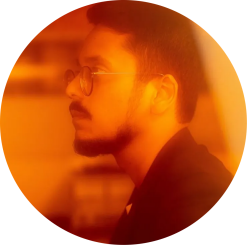
Ishraki Kazi
Q: 你最喜欢吃什么菜?你认为这个偏好与你的创作有关系吗?如果有的话是什么关系?
What's your favorite cuisine? Do you think this preference has anything to do with your creation? If so, what kind of relationship is it?
A: 这是一种来自孟加拉的街头小吃(Chotpotti 和 Fuchca),它总能唤起童年的回忆——那是一种怀旧之情,关于傍晚与家人围坐一起,或是站在街边,品尝每一口都在口中迸发出酸、辣、咸复合风味的“小包裹”。万事万物皆相连,从某种意义上说,是的,我对街头小吃的热爱确实在某种程度上映照进了我的行为艺术中。它不求极致精致或精英化,它旨在为公众所及。它追求风味的强烈,并且本质上就具有实验性。汲取旧有的形式,调整它以适应当下文化的新需求。
Chotpotti and Fuchca, it’s a street food dish from Bangladesh, it brings back memories of childhood, a nostalghia of sitting with family in the evening or standing on the side of the street and eating a tangy, spicy, salty pocket of flavor that bursts into your mouth with each bite. Everything is connected so in some sense yes, my love for street food is somewhat reflected into my performances, its not meant to be super refined or elite, its meant to be accessible for the public. Its meant to be powerful in its flavors and by nature it is designed to be experimental. Taking old forms and adapting it to fit new needs of the culture at hand.
Q: 你认为跨学科方法如何影响了你的艺术实践?
How do you think an interdisciplinary approach has influenced your artistic practice?
A: 年轻时的我曾以为,要成为一名艺术家,就必须纯粹地只做艺术,并放下所有其他兴趣。然而随着年龄增长,我意识到,要创作出足以探讨我所关注议题的、具有足够广度的作品,我必须融合艺术之外的领域,并深入各种知识体系的哲学之中。话虽如此,我自己对这些多元知识体系的掌握仍然极其有限,因此,当涉及行为艺术时,我常常信赖自己的直觉,任其引领方向,而非试图在智识上清晰地阐释现场发生的一切。我相信,我的身体懂得如何以比我受训的智力更为精微的方式进行沟通。
When I was younger I thought for me to be an artist, I had to be fully an artist and let go of any other interests. However as I have gotten older, I have realized that to make art that feels expansive enough to talk about the topics I am interested in, I need to incorporate fields outside of art and delve into the philosophy of all knowledge systems instead. That said, my own grasp of diverse knowledge systems is still ever so limited and thus when it comes to performance I often trust my intuition and let it lead the way without trying to intellectually articulate all that takes place during a live work. I trust that my body knows how to communicate in more nuance that my intellect has been trained to.
Q: 行为对你来说是什么?现在的空间里,你在意的是哪些关系?简单聊聊这些关系的基本结构吧。
What does performance art mean for you? In the current space, what relationships are you concerned with? Briefly discuss the basic structure of these relationships.
A: 我认为一个隐约的关切,是关于个人与集体之间的边界。即“我”止于何处,“我们”始于何方。
I think one loose concern I have is the boundary between the personal and the collective. Where I end and we begin.
Q; 你!是!谁!?
Who! Are! You!?
A: 我曾在许多场合试图回答这个问题,给自己许多不同版本、却都不完整的答案。而在最近寻求答案的过程中,浮现的解答是:我是宇宙微波背景辐射。
I have tried to answer this question on many occasions to myself with many variations of incomplete answers. The most recent answer that came to me along that search for answer is: I am cosmic background radiation
Q: 是否有些事物是你认为无法通过行为艺术转译或表达的?是否有些事物是你认为只能通过行为艺术转译或表达的?
Is there anything that you think is untranlatable or unexpressable through performance art?Is there anything that you think is only tranlatable or only expressable through performance art?A: 我认为这取决于艺术家本身,或许与行为艺术这一形式的关系并不大。当一位艺术家、科学家或任何领域的实践者,将其技艺掌握到真正精通的境界时,这种技艺本身便成为宇宙的一种表达。对他们而言,可以运用其独特的方法论,以深刻的方式真正地与宇宙建立联系。至于我,还远未达到任何此种精通的境界,只是行为艺术中有某种非常直接、真实且诚实的东西,正因如此,这些年来我常常被这种表达形式吸引,并一再回归其中。
I think it depends on the artist. And perhaps less to do with performance art. When an artist or a scientist or anyone for that matter has mastered a skill or craft to the level of true mastery, it becomes an expression of the universe and to them they can use their methods to truly relate to the universe in profound ways using their individual methodology. As for me, I am far from achieving any such level of mastery, though there is something quite immediate, real, and honest about performance art and that’s why I have often gravitated and re-gravitated to this form of expression throughout the years.
Q: 为什么做行为和表演?
Why do you do performance and performance art?
A: 三个答案:1.因为他人做不到,而拥有观众见证我能做他们不能或不愿做之事,让我感到特别。2.它让我能够表达那些我无法或选择不用言语表达的想法。3.转引保罗·格拉汉姆(Paul Graham)关于摄影的一句话:因为它既简单,又因为它很难。
3 answers:1.Because others cant do it and it makes me feel special to have audience witness something I can do that they cannot or will not2.It allows me to express ideas that I cannot/choose not to express in words3.To co-opt something Paul Graham said about photography: Because it is easy and because it is hard
Q: 你觉得科学、哲学、艺术的边界是什么?
What do you think are the boundaries between science, philosophy, and art
A: 与其将边界视为墙壁,我更喜欢将其视为亲戚间对话所需的空间与时间。这取决于亲戚们上一次进行亲密、真正诚实开放的交流是多久以前,就像那些持续到凌晨的长谈,之后身体感到疲惫,但精神却觉得充实而充满活力。在这样的对话中,边界消失了,我们能真正感受到彼此,并以相互尊重的真诚方式建立联系。这些学科也是如此。如果它们长期不交流,彼此就会显得陌生。然而,通过有意义且用心的相互交流,它们不再感觉像陌生人,而是为了相似的追求而努力的近亲——一个在验证和确认已知的同时,更好地理解未知的追求。
What do you think are the boundaries between science, philosophy, and art?Rather than thinking of boundaries as walls, I like to think of boundaries as the space and time in conversation between relatives. Depends how long ago the relatives had a close conversation, a truly honest and open conversation and check in, like those long conversations that go into the early hours of the morning and afterwards your bodies feel exhausted but your spirit feels enriched and vitalized. The boundaries disappear during such conversations and we can truly feel one another and relate in genuine ways of mutual respect. The disciplines are similar. If they don’t speak with one another for a long time, they seem stranger to one another. However, through meaningful and effortful check in with one another they no longer feel like strangers but rather close relatives towards a similar pursuit. A pursuit of better understanding the unknown while verifying and confirming the known.